
Higher-frequency brain rhythms -particularly in the alpha band -appear to produce more frequent perceptual sampling, increasing the likelihood of separating events in time and narrowing the temporal binding window (TBW). Slower oscillations, by contrast, yield fewer perceptual units, broadening the TBW and promoting temporal integration. While some findings have questioned the role of alpha frequency in perceptual resolution, the ongoing debate has underscored the need for more precise psychophysics and EEG analyses.
Well, recent work suggests that perception may operate in discrete temporal “frames” governed by neural oscillations :
New findings from researchers in Sweden and France suggest that the brain’s sense of bodily selfhood is not fixed, but dynamically regulated by alpha-band oscillations (≈8–12 Hz) in the parietal cortex. These rhythms act as a temporal filter, integrating visual and tactile signals to determine what is experienced as “me” versus “not me.”
Using EEG during the rubber hand illusion, the study shows that individuals with faster intrinsic alpha frequencies are more sensitive to sensory mismatches, preserving clearer body boundaries. Slower alpha rhythms, by contrast, widen the brain’s window for multisensory integration—making it easier to incorporate artificial limbs into the body schema.
Crucially, the researchers demonstrated causality: by applying transcranial alternating current stimulation (tACS) to speed up or slow down alpha oscillations, they directly altered participants’ susceptibility to the illusion. In effect, the neural mechanisms defining the self can be externally tuned.
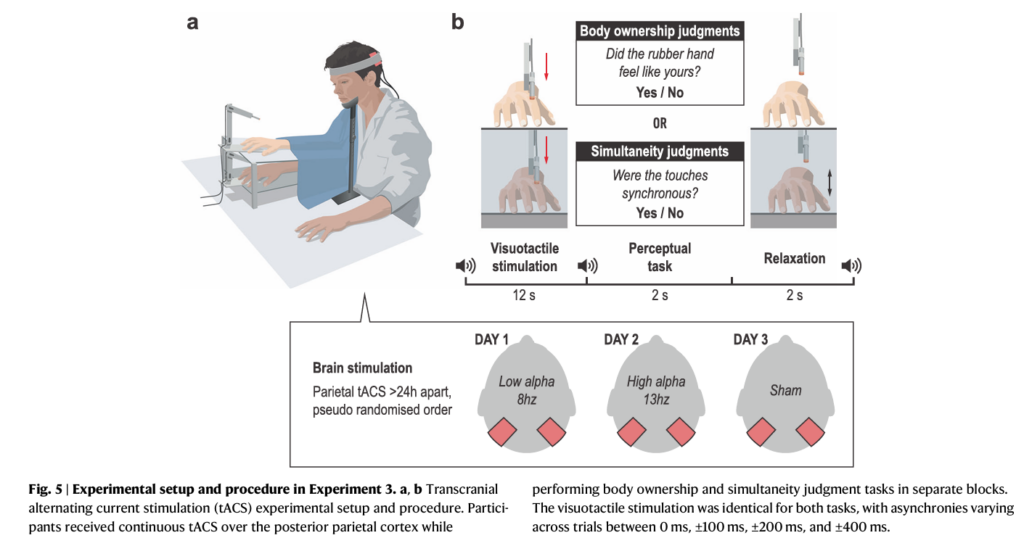
Published in Nature Communications, we think the work points toward a future where wearable neurostimulation and brain-computer interfaces could modulate embodiment on demand, with implications for prosthetics, neurorehabilitation, and immersive XR systems—any context where the brain must be persuaded that the artificial is part of the body.
Don’t forget also that the prefrontal cortex is not a primary source of alpha oscillations, it exerts top-down control over their frequency and amplitude through attention and task demands. This modulation shapes how narrowly sensory information is sampled, suggesting that wearable neurostimulation or neurofeedback systems could potentially be leveraged not only to alter perception, but also to influence attentional control.